A Short Course In
Bicycle Anatomy
Knowing bicycle anatomy helps you know what that do-hicky is that turns the whatchamacallit on your bike. Of course, you can always ask your bike shop but it's kind of cool to know yourself.
And if god forbid, you need to replace it you will at least know what to look for. Also, you can dazzle your friends with your new-found knowledge.
And if god forbid, you need to replace it you will at least know what
to look for. Also, you can dazzle your friends with your new-found
knowledge.
The images that are shown below of the road bike and the mountain bike, while very different, have the same basic components. There are a few differences like the suspension fork on the mountain bike or the drop handlebars on the road bike.
Although they are configured differently a frame is still a frame and handlebars are still handlebars etc. The components may differ, to accommodate different bicycle styles and riding conditions, but the names and functions are still the same.
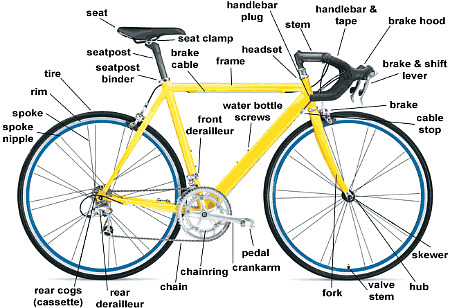
Anatomy of a road Bike
Check out this short video for even more details
The frame is the main component onto which the other components are mounted and consists of...
- top tube - connects the seat tube to the head tube
- seat tube - The seat tube contains the seatpost of the bike, which connects to the seat post
- seat stay - connects the top of the seat tube to the rear dropout
- head tube - houses the fork and bearings
- down tube - connects the bottom bracket to the head tube
- bottom bracket - houses the pedal axle and bearings
- dropouts - the slots in the frame and fork that holds the wheel axles
- chainstay - a section of the frame that connects the bottom bracket to the rear dropout
Some other key components are...
- fork - holds the front wheel and pivots in the headset when steering
- chainring - toothed rings that directly connect to the crank
- crank - connects the pedals to the chainring
- front derailleur - the mechanism that moves the chain from one chainring to another
- rear derailleur - the mechanism that moves the chain from one gear to another
- headset - houses the bearings that allow the handlebars and fork to turn
- cassette - toothed cog that make up the gears ( attached to the rear wheel)
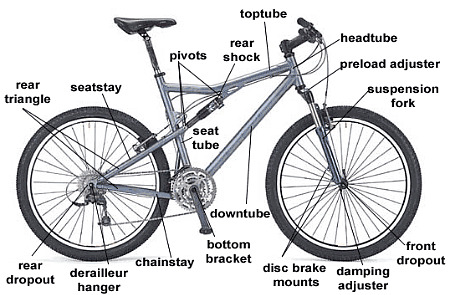
Anatomy of a mountain bike
There are many other styles of cycles besides the road bike and the mountain bike but the key components of a bicycle, tricycle, or recumbent remain basically the same.